
CASK gene disorders
A parent's guide to reading a genetic report
Genetic reports can look overwhelming at first. They are often written for doctors and scientists, so they contain lots of abbreviations, numbers and technical language. This guide explains some of the most common terms in plain English.
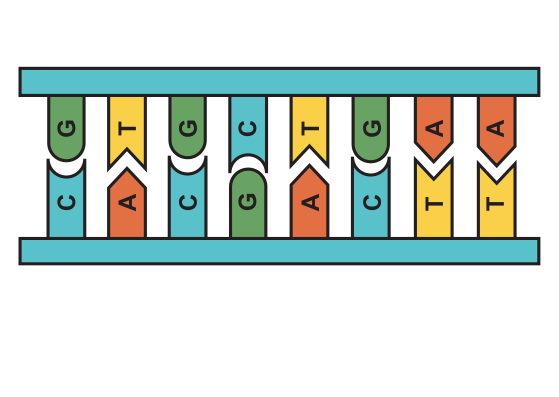
The basics
A genetic report is looking for changes (called variants or mutations) in a person's DNA.
DNA is made of four chemical "letters":
- A = Adenine
- T = Thymine
- C = Cytosine
- G = Guanine
These letters are arranged in a specific order, rather like letters in a sentence. Genes are sections of DNA that contain instructions for making proteins. Proteins help the body and brain grow and function properly. If the DNA letters change, the protein may not work correctly.
Understanding the gene name
Example: CASK gene
This tells you which gene has been affected. Each gene has a unique name, rather like a book title.
What does "variant" mean?
Example: Pathogenic variant in the CASK gene
A "variant" means there is a change in the DNA sequence. Different words describe how important the change is:
- Benign = harmless
- Likely benign = probably harmless
- Variant of uncertain significance (VUS) = not enough is known about this change to determine if it would cause disease
- Likely pathogenic = probably disease-causing
- Pathogenic = known to cause disease
Understanding the numbers and letters
You may see something like: c.2451del
This looks frightening but is just a code explaining the DNA change found:
c.= coding DNA sequence2451= the position in the gene where the change happeneddel= deletion (a piece of DNA is missing)
So c.2451del means: "A DNA letter was deleted at position 2451 in the gene."
Missense variant example
Example: c.214G>A — a single DNA letter has changed.
214= position in the geneG>A= the DNA letter G has changed to A
Duplication example
Example: c.1200_1203dup
1200_1203= the section of DNA involveddup= duplication
"A small section of DNA has been accidentally copied twice."
Common abbreviations in genetic reports
| Abbreviation | Meaning | Simple explanation |
|---|---|---|
| del | Deletion | Missing DNA letters |
| dup | Duplication | Extra copy of DNA |
| ins | Insertion | Extra DNA letters inserted |
| fs | Frameshift | The DNA message is shifted, often causing major problems |
| missense | Missense variant | One DNA letter change causes a different protein building block |
| nonsense | Nonsense variant | A change creates an early "stop signal" |
| splice | Splice variant | Affects how the gene instructions are put together |
Understanding protein changes
You may also see: p.Ile818fs
The p. stands for protein. Proteins are made from smaller building blocks called amino acids.
Ile= the amino acid isoleucine818= position in the proteinfs= frameshift
"At position 818 in the protein, the DNA change caused a frameshift." Frameshift changes often stop the protein working properly because they disrupt the rest of the genetic instructions.
Missense mutation example
Protein change: p.Arg72His
Arg= arginine (original amino acid)72= position in the proteinHis= histidine (new amino acid)
Duplication example
Protein change: p.Glu402Argfs*15
Glu= glutamic acid (original amino acid)402= protein positionArg= arginine (new amino acid)fs= frameshift*15= a stop signal occurs 15 amino acids later
What is a frameshift?
DNA is normally read in groups of three letters:
THE CAT ATE THE RAT
If one letter is removed:
THE ATA TET HER AT…
The whole message changes. This is similar to a frameshift mutation in DNA. Frameshift variants often have a bigger effect than single-letter changes.
What does "de novo" mean?
This means the genetic change was new in the child and was not inherited from either parent. It usually happens by chance when the egg or sperm was formed. Parents did not cause this.
Common medical terms seen in CASK reports
| Term | Meaning |
|---|---|
| MRI | A brain scan using magnets |
| Microcephaly | Smaller than expected head size |
| Developmental delay | Slower progress in learning or development |
| Cerebellar hypoplasia | Part of the brain developed smaller than expected |
| Pontocerebellar hypoplasia (PCH) | Underdevelopment of the cerebellum and pons areas of the brain |
Important things to remember
- Genetic reports are often written in technical language.
- Two children with the same gene change can still be very different.
- A report cannot always predict exactly how a child will develop.
- Research into rare genetic conditions is continuing all the time.
A quick example
Deletion — Pathogenic variant in CASK gene (c.2451del p.Ile818fs)
"A disease-causing change was found in the CASK gene. One DNA letter is missing at position 2451. This changes the way the protein is read from position 818 onwards, which is likely to stop the protein working properly or being made at all."
Missense — Likely pathogenic variant in CASK gene (c.214G>A p.Arg72His)
"At position 214 in the gene, the DNA letter G changed to A. This caused the protein building block at position 72 to change from arginine to histidine. It is likely to affect the way the protein works because of an amino acid change."
Duplication — Pathogenic variant in CASK gene (c.1200_1203dup p.Glu402Argfs*15)
"A duplication changed the reading frame of the protein. From position 402 onwards, the protein instructions became altered and an early stop signal appeared shortly afterwards. This is likely to stop the protein working properly or being made at all."
Final thoughts
It is completely normal to feel overwhelmed when reading a genetic report for the first time. You do not need to understand every abbreviation immediately. Genetics teams, genetic counsellors and patient support organisations can help explain what the findings mean for your child and family.